

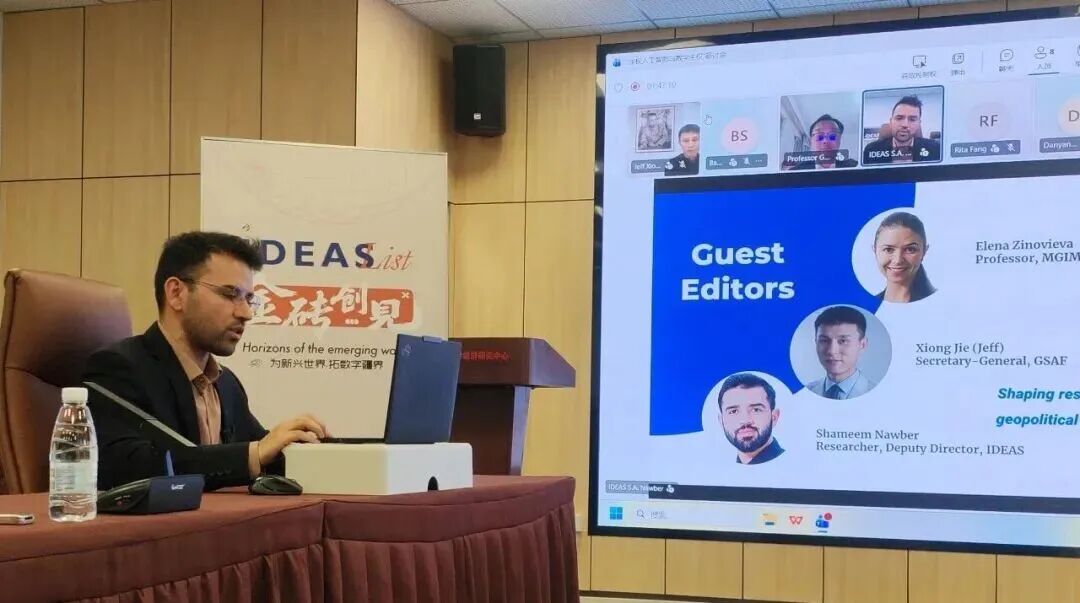
On March 20, the Global South Academic Forum (GSAF), the BRICS Innovation Base Digital Economy Research Center (IDEAS-BRICS), and Global South Insights (GSI) jointly held the first seminar of the “Sovereign AI and Digital Sovereignty” series. This series of seminars aims to facilitate in-depth research for the “Sovereign AI and Digital Sovereignty” column under the AI and Innovation (AI²) journal.
Breaking away from the traditional lecture format, the seminar unfolded as an in-depth dialogue, focusing on the core issue of how Global South countries can build and defend their digital sovereignty amid current geopolitical tensions and technological monopolies. Xiong Jie, Secretary General of the Global South Academic Forum; Bappa Sinha, a computer engineer from India’s free software movement; Zheng Ge, Professor at KoGuan Law School, Shanghai Jiao Tong University; and Yu Xiao, Executive Secretary General of the Center and Executive Editor-in-Chief of AI², presented profound insights from multiple perspectives—including data value extraction, national and class interests, legal and technical architectures, and empirical research—offering valuable solutions for the digital infrastructure development of developing countries.
At the beginning of the seminar, Dr. Shameem A. Nawber, Deputy Director of the BRICS Innovation Base Digital Economy Research Center, delivered opening remarks as the moderator, clarifying the core direction and agenda of the seminar. He first detailed the background and four major research directions of the AI² journal and the “Sovereign AI and Digital Sovereignty” column, explaining the core positioning of this seminar series: to facilitate interdisciplinary intellectual exchange before formal academic research and to build a dialogue platform for diverse perspectives. He also provided a clear definition of the “Global South” in this discussion, referring to developing countries and regions that, due to historical structural factors, have relatively limited participation in the formulation of global digital governance norms and started late in building digital technology infrastructure.
The seminar was held in a hybrid online-offline format, with participants from academia, policy circles, and industry across multiple countries and regions. This Asia session was the first event in the series, to be followed by regional sessions on Eurasia, Africa, and Latin America, covering the main regions of the Global South.
The seminar was structured around seven thematic modules, proceeding step by step: starting with the definition of core concepts (Module 1), then moving to quantitative measurement of digital sovereignty (Module 2), legal regulation and governance system construction (Module 3), infrastructure construction and open-source technology pathways (Module 4), analysis of digital governance from a geopolitical perspective (Module 5), future research agenda planning (Module 6), and concluding with a rapid-fire Q&A session (Module 7).
Module 5 was originally scheduled to focus on Southeast Asia, but due to the last-minute absence of a Malaysian guest, the discussion shifted to focus primarily on the cases of India and China, while also incorporating experiences from other relevant countries. The seminar invited each guest to identify one cognitive misunderstanding about the current state of digital sovereignty practices in Global South countries that urgently needs correction, and to offer one actionable recommendation, grounding deep discussion and intellectual exchange in practical realities.
Xiong Jie: Data as an Asset, Calling for a “Digital Sovereignty Index” and Alternatives
In his remarks, Xiong Jie first pointed out that in today’s AI era, data has become a high-value resource (like “new oil”) that can be monetized. However, Global South countries face a serious challenge: their valuable data resources are being extracted and turned into assets by a few U.S. tech giants without compensation, while the people of the data-generating countries do not benefit from the development of the digital economy and even find their national security and information autonomy constrained.
To help Global South countries clearly define and measure the problems they face, Xiong Jie introduced the “Digital Sovereignty Index (DSI)” developed by his team. He noted that many countries attempt to restrict cross-border data flows through legislation, but without domestic data centers and infrastructure, such control is often weak, and multinational giants (such as Google or Facebook) can easily force governments to compromise.
Xiong Jie emphasized that identifying shortcomings in digital sovereignty is not about assigning blame but about finding feasible alternatives. Faced with Western technological monopolies, Global South countries cannot simply remain aware of the lack of underlying infrastructure; they must begin thinking about how to build alternative technological pathways that truly serve their own interests, using infrastructure solutions from China or open-source technologies. He also cited recent conflicts in the Middle East as a warning: excessive reliance on foreign hardware and communication devices can exact a heavy toll in human lives, underscoring once again the urgency of digital sovereignty.

Image Captions: Xiong Jie speaking at the seminar.
Bappa Sinha: Beware of “False Sovereignty,” Calling for Grassroots Independence and Open-Source Development
Bappa Sinha, an expert from India, offered a critical perspective for the seminar. He sharply noted that when discussing digital sovereignty, one must distinguish between “the sovereignty of the people” and “the sovereignty of the ruling class.” In many Global South countries, the ruling class often has not fully severed its ties with Western systems; what they pursue may be merely a share of the profits from multinational giants (such as joint-venture data centers and profit sharing) rather than genuine technological independence.
Sinha used India’s digital payment system to illustrate this “false prosperity.” Although India has established a domestic backend network for the Unified Payments Interface (UPI), up to 85% of the front-end payment application endpoints are controlled by two U.S. companies. In hardware manufacturing, despite India having introduced a large amount of mobile phone assembly business, the lack of core component manufacturing capacity means that as assembly volume increases, the cost of importing components soars, without truly enhancing the country’s digital sovereignty. He also mentioned that under tremendous pressure and threats from U.S. multinationals, India’s data localization laws, originally intended to safeguard national sovereignty, were progressively weakened and compromised.
Sinha warned that the digital economy and the real economy are now inseparable, and a lack of sovereignty poses fatal national security risks. For example, during the Russia-Ukraine conflict, Mastercard and Visa cut off services to Russia, instantly paralyzing the payment system. In Iran, the Starlink network, which is not under government control, has been used for espionage communications and intelligence infiltration. As a way out, he suggested that developing countries should break free from the narratives set by the World Bank and Western consulting firms, leverage their domestic engineers, use government funding to support internal projects, and vigorously embrace open-source implementations to build digital infrastructure with independent will.
Zheng Ge: Resonance Between Law and Technology, Building a Multi-Dimensional Digital Sovereignty Architecture
Professor Zheng Ge, starting from the intersection of law and artificial intelligence, systematically explained how states should build sovereign AI. He proposed that measuring digital sovereignty should include four dimensions: technology and infrastructure control (e.g., semiconductors, cloud platforms), data control (cross-border flows and storage), regulatory and normative control (e.g., privacy and AI ethics rules), and economic and strategic autonomy.
He pointed out that sovereign AI is not just a legal concept but a combination of “physical foundation and superstructure.” China’s legislative practice in AI provides a comprehensive model: from the Cybersecurity Law of the People’s Republic of China, the Data Security Law of the People’s Republic of China, to the Personal Information Protection Law of the People’s Republic of China, and then to special administrative regulations on generative AI and recommendation algorithms, forming a complete legal protection system. However, he also emphasized that law cannot exist in isolation from technological and economic capabilities. The fundamental reason China can implement strict regulations and resist external hegemony lies in its strong position as a manufacturing hub and its complete innovation ecosystem. When foreign tech giants enter a country, the state needs to comprehensively consider national security, data localization, and even use legal means to prevent algorithmic addiction control over young people.
Yu Xiao: Focus on Meso-Level Empirical Research, Warning Against the Risk of “Internal Sovereignty Transfer” in Digital Governance
From an academic research perspective, Yu Xiao directly identified the core blind spot where current theoretical discussions of digital sovereignty are disconnected from practical implementation. He proposed that digital sovereignty research currently falls into a polarized dilemma: at the macro level, international relations research mostly focuses on geopolitics and external sovereignty struggles, leaning toward theoretical macro-discourse; at the micro level, computer science research concentrates on technical security alignment and technical indicator optimization, lacking linkage with national governance considerations. The missing link is serious: meso-level empirical research that connects theory and practice. To fill this gap, he raised a core question: when AI systems are deeply deployed in government public governance and critical infrastructure operations, do such technologies strengthen the coherence of bureaucratic governance and improve governance efficiency, or do they lead to the fragmentation of accountability mechanisms in public governance and weaken the state’s autonomous governance capacity?
Yu Xiao emphasized that for Global South countries, digital sovereignty is by no means an empty slogan but a pragmatic survival imperative related to national security and development. The practical lessons from the Middle East fully demonstrate that true digital sovereignty centers on possessing the core capability to independently complete the design, security auditing, and iterative upgrades of the underlying models of digital infrastructure. Only then can countries ensure that key areas such as hospitals, power grids, and financial systems are not threatened by external technology cutoffs or remote control when geopolitical situations suddenly shift.
On this basis, he innovatively proposed the core concept of “internal sovereignty transfer,” refining a two-tier theoretical framework for digital sovereignty: digital sovereignty includes not only external sovereignty (resisting external technological monopolies, data colonialism, and external interference) but also internal sovereignty (the state’s autonomous control over domestic digital infrastructure and core algorithms). He further warned that even if a country achieves 100% localization of hardware and software, if the governing body cannot grasp the underlying logic of algorithms, lacks the ability to independently operate, maintain, and iterate systems, and relies entirely on external suppliers for system updates, troubleshooting, and technical debugging, then the space for public policy formulation and implementation will be locked by technical architectures and constrained by algorithmic black boxes. This would ultimately lead to a hidden transfer of national governance authority and a loss of absolute control over the internal digital governance system—a new, latent risk to national sovereignty in the digital age.

Conclusion
This seminar charted a course for Global South countries to achieve a digital breakthrough in the age of artificial intelligence. After thorough discussion, the participating experts reached a consensus: digital sovereignty is not a single project; it requires countries to make comprehensive strategic deployments in data governance, technology infrastructure research and development, legal framework construction, and local talent cultivation. Global South countries urgently need to break free from path dependency, explore open-source alternatives through South-South cooperation, and truly “hard-code” sovereignty awareness into the underlying architecture of the digital economy, thereby gaining genuine strategic initiative in future digital competition.
As one of the organizers, the Global South Academic Forum will continue to work with its partners to promote regional dialogues, uncover differentiated challenges and local solutions for digital sovereignty in different regions, build an action-oriented knowledge network, and systematically enhance the Global South’s voice in global digital governance.
The entire seminar was recorded, and the complete video will be edited and published on media platforms. Interested readers are welcome to watch: for Chinese platforms, please search for “Digital BRICS (数智金砖)” under the same name; for English platforms, please follow “Multipole.”
The topics discussed in this seminar are core directions continuously pursued by the “Sovereign AI and Digital Sovereignty” column under the AI and Innovation journal. The column welcomes high-quality submissions from scholars worldwide, policy researchers, and industry practitioners, encouraging interdisciplinary perspectives and empirical research. For details, please click “Read the original” to visit the journal’s homepage:
https://onlinelibrary.wiley.com/journal/30673941
(All images were provided by the original author(s).)