

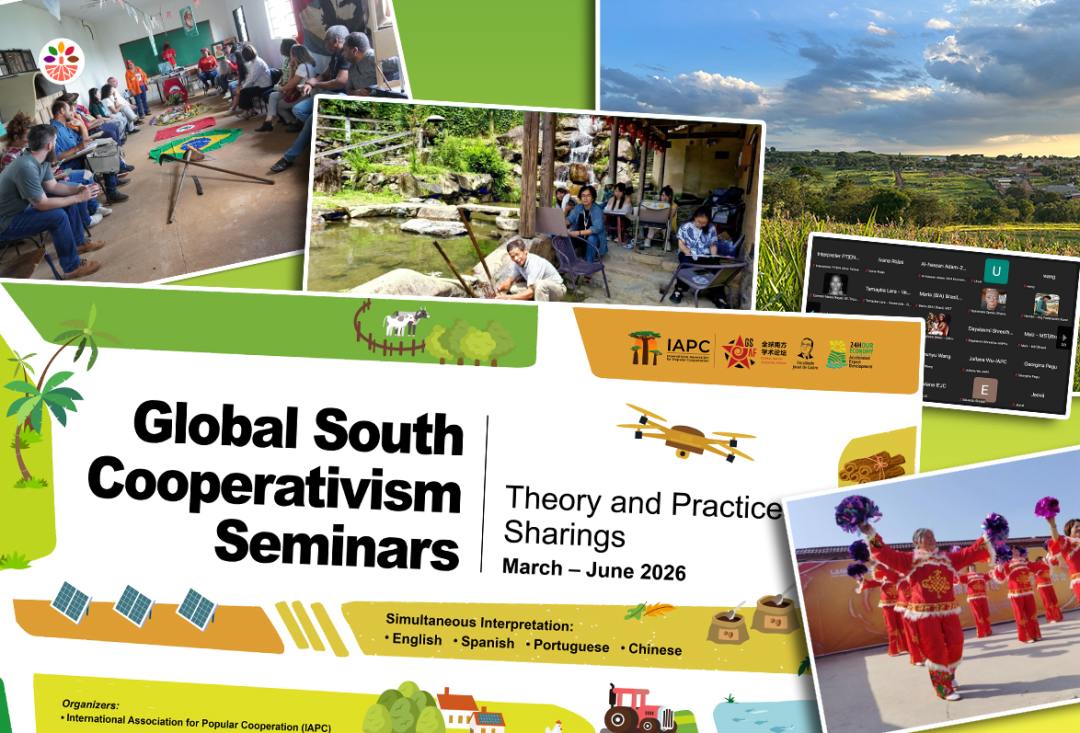
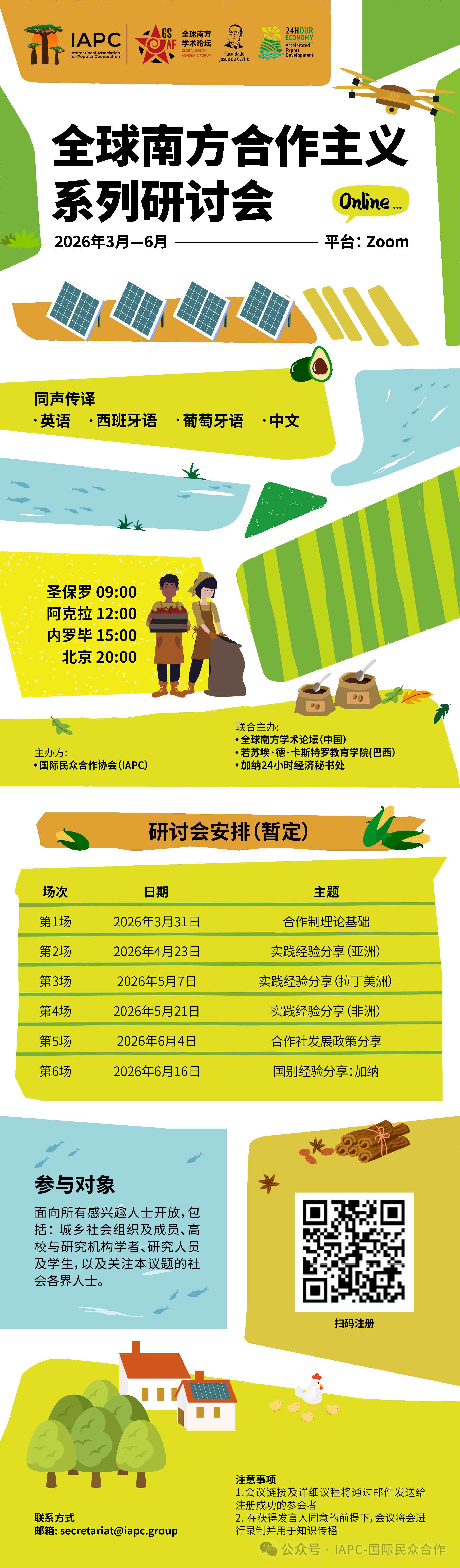
On March 31, 2026, the “Global South Cooperatism” online seminar series, initiated by the International Association for Popular Cooperation (IAPC) and co-organized by the Global South Academic Forum, the Faculdade Josué de Castro (Brazil), and the 24-Hour Economy Secretariat (24H+) of Ghana, was officially launched. This series comprises six thematic sessions and will continue until June. The seminar series aims to build a platform for sharing knowledge and fostering dialogue on the theory and practice of “Global South cooperatism,” showcasing successful models and promoting mutual learning among Global South countries in the areas of inclusive growth and sustainable development.
The theme of the first seminar was “Theoretical Foundations of Cooperation.” The session featured simultaneous interpretation in Chinese, English, Spanish, and Portuguese and attracted 87 participants from 19 countries across Asia, Africa, and Latin America, including scholars, cooperative practitioners, non-governmental organization members, government officials, and rural development advocates.
Luiz Zarref, IAPC Coordinator for Latin America, stated in his opening address that in the face of common systemic challenges, the Global South must re-examine and reactivate “cooperation” as a fundamental survival and development wisdom. He emphasized that true cooperatism should serve as a weapon for workers to respond to shocks and pursue collective liberation, rather than a tool tamed by market logic.
As the first lecture of the seminar series, this session specially invited two keynote speakers: Dr. Adalberto Martins, a researcher with the Landless Rural Workers’ Movement (Movimento dos Trabalhadores Rurais Sem Terra, MST) in Brazil, and Associate Professor Dong Xiaodan from the School of Agricultural Economics and Rural Development at Renmin University of China. Dr. Martins affirmed that cooperation is a fundamental element of human development and shared the three stages of cooperative policies and their challenges within the MST. Professor Dong Xiaodan elaborated on China’s cooperative theories and rural practices. The two sets of theories and practices shared commonalities while also exhibiting local differences, offering experience and intellectual inspiration for Global South countries exploring pathways to cooperative practice.
1. The Brazilian Experience: MST’s Theory and Practice of Promoting Agricultural Cooperation
In his lecture, Dr. Martins pointed out that cooperation is a fundamental factor in the development of human society, endowed with different political connotations in different historical stages. He identified two essential levels for successful cooperation: the “action” of the participants (creating the material basis to support cooperation) and their “attitude” (cognition and political awareness). He first noted that when promoting cooperation, certain necessary material conditions must be present; otherwise, complex cooperative models cannot be implemented. Simultaneously, it is necessary to help cooperative members understand the strategic plan, thereby enhancing their cognitive level and political awareness.
Dr. Martins noted that cooperation has always existed in agricultural work, taking various spontaneous forms. In Brazil, this is called “Mutirão” (collective mutual aid labor). Constrained by tradition and the material conditions imposed by simple commodity economy, smallholder production units (families or groups) are forced to implement simple cooperation under the context of capitalist exploitation. This is a temporary collective activity that begins and ends with a single process (such as planting, harvesting, or borrowing equipment) and does not evolve into complex cooperation. This situation also hinders deeper, complex cooperation that could socialize capital, land, and labor. The reasons include smallholders’ distrust of the output produced by “others,” limitations in education, and, most crucially, the constraints of their material conditions of production and life. Dr. Martins further pointed out that under these circumstances, when working with rural communities, efforts must be dedicated to promoting more complex forms of cooperation.
Reviewing the development trajectory of the MST, Dr. Martins indicated that cooperation is the cornerstone of the organization and has always been guided by the political goal of “obtaining land.” Over its 42-year history, and with the shifting political and social forces in Brazil, the MST’s understanding of cooperative labor has matured, leading to continuous adjustments in its related cooperative policies.
In the early stage of cooperation (the 1980s), influenced by Catholic traditions, MST members, after occupying land and forming communities, created a form of cooperation known as “semi-collective groups.” Adhering to the concept that “all are brothers,” they pursued equality and distributed all production outputs equally among participating families. However, due to differing levels of labor input from various families, the equal distribution method struggled to reflect the value of labor, ultimately leading to challenges regarding distributive fairness. Many semi-collective groups became unsustainable and eventually disintegrated.
During the period of collective groups (the late 1980s), against the historical backdrop of popular uprisings mobilizing to end the military dictatorship and hold general elections, the MST formulated more systematic cooperative policies in the late 1980s. In 1989, with the slogan “Occupy, Resist, Produce,” the MST’s National Production Department established the “Cooperativist System of Settlers” (o Sistema Cooperativista dos Assentados, “SCA”). At the national level, it created the “Confederation of Land Reform Cooperatives of Brazil” (nacionalmente a Confederação das Cooperativas de Reforma Agrária do Brasil, “CONCRAB”), and at the state level, it established central cooperatives. The organizational form of cooperation at this time was the “fully collective group,” where land, capital, and labor were all managed collectively. The political principle was “from each according to his ability, to each according to his labor,” and the legal form was the registration and establishment of “Agricultural and Livestock Production Cooperatives” (Cooperativas de Produção Agropecuárias, “CPAs”). Lessons learned in practice included the necessity for cooperation to help peasants overcome obstacles to individual development and increase income in order to maintain cooperative enthusiasm; otherwise, dissolution would follow. During the cooperative process, land and capital were not the hindering factors; the most difficult element to integrate turned out to be labor itself. Notably, social capital secured through political struggle during this phase provided support for the continued advancement of cooperation.
During the period of cooperative popularization (from the mid-1990s to the present), the MST advanced the Labor Cooperative (Cooperativa de Comercialização e Prestação de Serviços, “CPS”) to provide small farmers with services such as machinery operation, agricultural input procurement, product sales, technical assistance, and credit development. It also utilized credit lines to build facilities like warehouses and processing plants to expand capital for the cooperatives. This stage also brought new challenges and lessons, such as how to massively integrate settled families into cooperation for effective political organization, preserving their inherent political and social transformative drive rather than merely reducing them to ordinary commercial cooperatives. Other challenges included how to establish a clear economic strategy, involving multiple production sectors, to prevent cooperatives from defaulting on debts and to increase member incomes, and how to control all links of the industrial chain to replicate successful regional cooperative models.
To date, the MST continues to promote cooperation nationwide, involving approximately 185 cooperatives and over 1,900 associations, benefiting more than 400,000 peasant families. It also faces political, organizational, and managerial challenges. Politically, it combats the growth of far-right forces in Brazil and continues to advance land reform. Organizationally, within settlements, it works with partners to promote healthy food production and agroecological transition through advanced technology and mechanization. In terms of cooperative management, while maintaining the organization’s political values, it organizes resources, accumulates capital, deepens collaboration between cooperatives, and consistently preserves its character and strength in driving Brazil’s revolution.
2. The Chinese Experience: Theoretical Discussion and Characteristic Analysis of Cooperation
Professor Dong Xiaodan led an in-depth discussion on cooperation, systematically analyzing its origins, modern value, core mechanisms, and practical challenges and opportunities. She illustrated the diverse connotations and development paths of cooperation through theoretical frameworks and case studies.
The lecture pointed out that cooperation is a survival instinct and rational choice for both living organisms and human beings. Constrained by geographical climate variations, uneven distribution of water and soil resources, and frequent natural disasters, traditional Chinese agricultural civilization developed cooperative models such as mutual production aid, irrigation infrastructure, community defense, and shared daily tasks. In modern society, cooperation addresses social equity and sustainable development, creating “organizational rent” through complementarity, breaking through individual resource bottlenecks, and forming systemic competitive advantages. From the development perspective of Global South countries, cooperation is also closely linked to national sovereignty. Professor Dong Xiaodan’s research group had previously proposed the “3S” development goals for Southern countries oriented towards ecological civilization: resource and environmental Sovereignty, Social Solidarity, and Sustainable human Security.
The core mechanisms of cooperation involve clearly defining member boundaries and establishing internal pricing, including determining member status, profit distribution, and capturing differential returns. In China’s rural construction practice, cultural activities provide a low-cost way to initiate cooperation, the purchase and sale of agricultural inputs offer the quickest results, and financial cooperation serves as a key support.
Currently, rural cooperation in China faces several challenges, including labor mobility and elite control over resource allocation. However, new opportunities are also emerging: under the construction of China’s ecological civilization, diverse actors (such as farmers with traditional production skills) are participating on the production side; consumers are actively engaging in the production process, for example, urban residents purchasing directly from designated farmers; e-commerce reaching rural areas (e.g., the JD.com Wuchang Rice case) and the rise of “digital nomads” (e.g., the Pingnan County, Fujian case) present immense possibilities for expanding cooperative income; and cultural cooperation is driving the integration of primary, secondary, and tertiary industries (e.g., the “Village Super League” or “Cun Chao” case in Rongjiang County, Guizhou).
Overall, multi-dimensional cooperation represents a crucial direction for achieving sustainable rural development. Seizing the opportunities presented by ecological civilization construction and digital transformation, and activating rural resources and vitality through diverse forms of cooperation, can both mitigate the social impacts of urbanization and promote high-quality rural development, making cooperation an important pillar of rural revitalization.
3. Focused Interaction: Common Concerns of the Global South
During the 30-minute Q&A session, questions from participants across various countries vividly reflected the shared concerns and reflections of the Global South on cooperation issues.
Membership Boundaries in Cooperatives: The Dialectical Relationship Between Worker and Employee
The nature of personnel within cooperatives sparked immediate discussion: are cooperative workers members or wage employees? Dr. Martins used the Brazilian MST as an example to illustrate the complexity of identity within cooperatives. He explained that MST cooperatives have a clear class character, with members being peasant families settled in land reform settlements, fundamentally different from traditional cooperatives dominated by large capital that essentially operate as corporations. However, he also acknowledged that even within MST cooperatives, for reasons of professional specialization, salaried workers are hired for specific positions, constituting a real-world contradiction.
Institutional Flexibility and Distribution Mechanisms in Chinese Cooperatives
Responding to a question about the rules for member inclusion in Chinese cooperatives, Professor Dong Xiaodan introduced the three-tiered legal framework of China’s rural cooperative system. She noted that the “Law of the People’s Republic of China on Professional Farmers’ Cooperatives” offers considerable flexibility, allowing cooperatives to register as enterprises and providing elasticity in membership and capital changes. However, under the system of collective land ownership, rules regarding membership qualifications, land use rights allocation, and benefit arrangements are clearly defined. She further explained that income distribution within cooperatives is not simply equal but is adjusted comprehensively based on factors such as family size, age structure, and medical needs, reflecting an institutional design aimed at balancing fairness and efficiency within the framework of collective ownership. Professor Dong also pointed out that in China, cooperatives are also endowed with the strategic function of coordinating rural resources and acting as a “reservoir” for labor during urbanization. Their development is shaped by clear rules and guiding mechanisms.
Rural Space and the Role of Organizations in the Context of Urbanization
When asked about the significance of cooperatives in China’s rural urbanization process, Professor Dong Xiaodan drew on Chinese experience to explain that if urbanization proceeds in a disorderly manner, with a massive influx of labor into cities unable to find full employment, it would intensify social pressures in both urban and rural areas. She emphasized that cooperatives, as rural organizational entities, can coordinate resource allocation beyond the logic of the market, preserving employment and livelihood spaces in the countryside. The key issue lies in “who leads this process and how the mechanisms are designed”—that is, establishing sound governance structures and planning mechanisms for urban-rural development.
Remuneration Distribution Within Cooperatives: Democratic Consultation and Dynamic Adjustment
Regarding internal governance, in response to a question about compensation mechanisms, Professor Dong Xiaodan explained that cooperative remuneration rules are not static but are continuously discussed and dynamically adjusted through internal democratic consultation. Management and specialized positions may sometimes have different compensation standards, but the overall distribution plan is revised according to the cooperative’s operational cycle. This mechanism acknowledges labor differences while ensuring transparency and fairness in the distribution process through internal democracy, avoiding the complete surrender of differentiation to market forces.
4. Conclusion
The first session of the “Global South Cooperatism” seminar series was held on March 31. This session provided participants with theoretical foundations and shared practical experiences from China and Brazil. Notably, this inaugural session set the tone for the entire six-part series. Its profound significance lies in its attempt to rethink and redefine the meaning and potential of “cooperation” by moving away from the inherent models of capitalism.
The second seminar will be held on April 23, where we will hear experience sharing from rural China and the state of Kerala in India. Interested friends can scan the QR code on the poster to register. We look forward to discussing and exchanging ideas with you!
(All images were provided by the original author(s).)